
'%3E%3Cpath id='Path_1190' data-name='Path 1190' d='M0,0H33.5' transform='translate(1803.5 55.667)'/%3E%3Cpath id='Path_1190_-_Outline' data-name='Path 1190 - Outline' d='M33.5.5H0v-1H33.5Z' transform='translate(1803.5 55.667)'/%3E%3Cpath id='Line_11' data-name='Line 11' d='M33.5.5H0v-1H33.5Z' transform='translate(1803.5 68.667)'/%3E%3Cpath id='Line_7' data-name='Line 7' d='M33.5.5H0v-1H33.5Z' transform='translate(1803.5 42.667)'/%3E%3C/g%3E%3C/svg%3E%0A)
'%3E%3Cpath id='Line_69' data-name='Line 69' d='M31.646,32.354l-32-32L.354-.354l32,32Z' transform='translate(1878.5 10.5)'/%3E%3Cpath id='Line_70' data-name='Line 70' d='M.354,32.354l-.707-.707,32-32,.707.707Z' transform='translate(1878.5 10.5)'/%3E%3C/g%3E%3C/svg%3E)
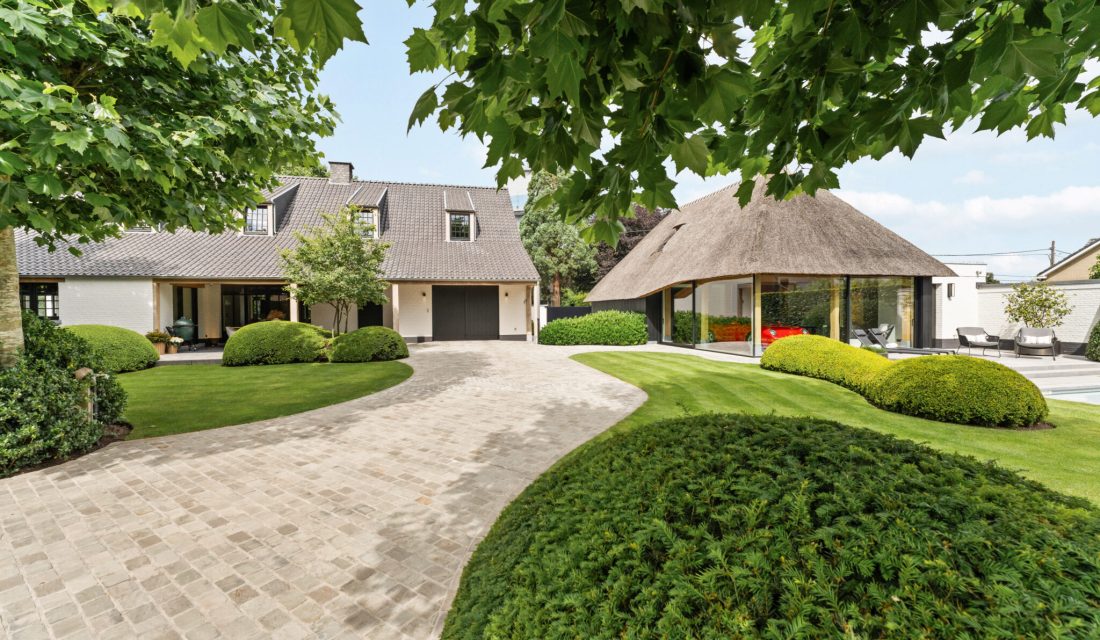
In a luxury home, technology should enhance living comfort without detracting from the tranquillity, aesthetics and elegance of the interior. Well-thought-out smart home design is therefore not just about functions, but above all about the way in which lighting, climate control, security and control systems are integrated into the home. For anyone considering an exclusive home, it makes sense to look beyond the term ‘home automation’ alone and assess just how smart, discreet and future-proof the system really is.
What smart home design really means in a luxury home
In high-end property, smart home design often emphasises ease of use and seamless integration with the architecture and finishes of the home, rather than adding as many separate devices as possible. A home only feels truly sophisticated when smart systems operate intuitively and blend visually into the overall design. Think of lighting that creates different atmospheres, climate control that can be adjusted zone by zone, security that is discreetly present, and centralised control that provides clarity rather than complexity.
The added value often lies in the quality of the integration and the user experience, not in the number of individual gadgets. In a well-designed home, technology, interior design and daily routines are seamlessly integrated. This not only makes a home more comfortable, but also more enjoyable to live in and easier to manage.
The key smart features in luxury homes
Not every installation has the same impact on the living experience. Owners and buyers often prioritise smart features that enhance comfort and safety.
- Lighting and ambience settings – central control and pre-set scenes for living, dining, evening relaxation or entertaining.
- Climate control – control of heating, cooling and ventilation on a room-by-room or zone-by-zone basis.
- Security – integration of alarm systems, access control, video door entry and notifications.
- Sun blinds and curtains – automatic control for comfort, privacy and light control.
- Audio and entertainment – enjoy music and home cinema with ease, without the need for separate devices or visual clutter.
When these functions are coordinated, this is what distinguishes a home with isolated smart features from one with a coherent smart home concept. In new-build projects, these choices can be incorporated into the design from the very outset.
Why design and technology should be assessed together
In an exclusive home, the technical installations are only part of the story. Equally important is how these solutions are integrated into the design. Designers often recommend that smart-home technology in luxury homes should remain concealed or blend into the interior, so that it does not stand out as ‘tech’. Fragmented controls or disparate systems with separate apps can detract from the sense of tranquillity and quality expected of a luxury home.
Good smart home design is unobtrusive. Control elements are positioned logically, technical components are concealed as much as possible, and the home remains easy to navigate. This is particularly important in properties where the architecture, choice of materials and interior finishes have been executed to a high standard. Technology should complement this, not detract from it.
What you, as a buyer, should look out for when assessing a property
When purchasing a luxury property fitted with state-of-the-art technology, it is not enough simply to ask whether home automation is installed. It is important to understand exactly what has been installed, what is included in the sale and what condition the systems are in. This helps to avoid unpleasant surprises after the transfer of ownership.
Legal distinction: immovable property by incorporation versus movable components
In the context of smart home installations, there is a crucial legal distinction. Systems and components that items that are permanent and permanently attached to the property – such as built-in cabling, integrated lighting systems, fixed control panels and built-in screens – are legally regarded as immovable property by virtue of incorporation (Civil Code, Article 3.47). These items are included in the sale by operation of law, unless the parties expressly agree otherwise in writing.
Standalone or movable smart home components – such as wireless sensors, detachable devices or, in some cases, standalone cameras – are movable property and may be taken away by the seller unless they are explicitly included in the sales agreement as being part of the sale.
It is therefore essential, when purchasing luxury property fitted with smart home systems, to specify in the sale agreement, for each component, which items are immovable property by virtue of incorporation and which are movable property, so that both parties are aware of what remains in place at the time of the transfer.
In addition to this legal distinction, the following factors should be taken into account in the assessment:
- Scope of the installation – which functions are effectively linked: lighting, alarm, climate control, sun blinds, audio or access?
- Control – is control centralised and intuitive, or is it managed via several separate systems?
- State of the art – are the installations well maintained and fully operational?
- Included items – which panels, screens, sensors, cameras or other components remain on site after the sale, and are they immovable by virtue of being incorporated into the property or movable?
- Documentation – are manuals, diagrams, login details and technical specifications available?
- Practical handover – is it clear how the new owner will manage the installation after completion?
In the luxury property sector, this check is an essential part of a thorough due diligence. This offers extra reassurance, particularly for international buyers, during what is often a complex purchasing process.
The impact on quality of life and perceived value
A well-integrated smart home system can significantly enhance the experience of a luxury home. Comfort becomes more consistent, daily tasks run more smoothly and the home feels more complete. This is particularly true when smart features do not feel like technical add-ons, but rather like a natural part of the living concept.
This also plays a part in market perception. In the property sector, a growing proportion of buyers in the higher-end market regard smart-home technology as an integral part of living comfort. This does not mean that every property must be fully automated, but rather that the systems in place must be logical, practical and appropriate to the standard of the property. Issues such as energy consumption and future standards also play a role in this regard, particularly in light of EPC and energy requirements.
Smart home design also requires clear purchasing advice
When assessing luxury properties, it is wise to consider not only the location, finish and size, but also the property’s technical specifications. In luxury properties, home automation, alarm systems and climate control can be key components of the overall picture. Expert guidance will help you ensure that these elements are properly taken into account in the valuation of the property and in the subsequent purchase decision – including the legal distinction between what constitutes immovable property by virtue of incorporation and what remains movable property.
For buyers seeking exceptional property in Belgium, a discreet and expert approach is essential. Particularly when it comes to exclusive homes with state-of-the-art systems, a thorough and clear assessment makes the difference between an attractive presentation and a truly sound purchase. Anyone wishing to integrate technology at an early stage in the construction and design process may also wish to read the article ‘Turnkey solutions for high-end homes’.
Frequently asked questions
What is the difference between home automation and a smart home?
In practice, the terms ‘home automation’ and ‘smart home’ are often used interchangeably to refer to (internet-)connected home automation systems, such as lighting, heating, sun blinds or security. Sometimes, the term ‘smart home’ is used to emphasise greater interconnectivity, centralised control and smart scenarios. In luxury homes, what matters most is how user-friendly and integrated the system is as a whole, not simply which term is used.
What is a smart home design?
A smart home design is a housing concept in which technology is taken into account right from the start
is about architecture, interior design and living comfort. The aim is for smart features to feel intuitive, remain visually unobtrusive and enhance the quality of life without the intrusive presence of technology. In this context, lighting design in luxury homes is also closely aligned with the way in which atmosphere and comfort are designed.
How much does a smart home cost in a luxury property?
That depends very much on the size of the property, the number of integrated functions and the standard of finish. For buyers of existing luxury properties, the most important question is usually not just what the original installation cost, but above all which systems are in place, what condition they are in, what exactly is included in the sale, and which components are legally classified as immovable property by virtue of incorporation as opposed to movable property.
What is the difference between a smart home and a normal home?
A smart home features interconnected systems that simplify comfort, security and management. In a conventional home, these functions are more often carried out separately and manually. In the luxury segment, the difference lies primarily in the quality of the integration: the less visible the technology and the more intuitive the controls, the better the living experience.
'%3E%3Cg id='Group_551' data-name='Group 551' transform='translate(-74 -5252.672)'%3E%3Cg id='Group_542' data-name='Group 542' transform='translate(910 5353.672)' opacity='0.6'%3E%3Crect id='Rectangle_560' data-name='Rectangle 560' width='2.577' height='11.167' transform='translate(0 4.009)' fill='%23403f4b'/%3E%3Ccircle id='Ellipse_29' data-name='Ellipse 29' cx='1.5' cy='1.5' r='1.5' transform='translate(0.242)' fill='%23403f4b'/%3E%3Cpath id='Path_1184' data-name='Path 1184' d='M463.711,106.255c0-2.971-.643-5.255-4.119-5.255a3.612,3.612,0,0,0-3.25,1.782h-.048v-1.507H453v11.032h3.434v-5.457c0-1.439.273-2.833,2.06-2.833,1.76,0,1.786,1.646,1.786,2.925v5.365h3.432Z' transform='translate(-448.211 -96.989)' fill='%23403f4b'/%3E%3C/g%3E%3C/g%3E%3Cg id='Ellipse_33' data-name='Ellipse 33' transform='translate(820 85)' fill='none' stroke='%23e2e2e4' stroke-width='1'%3E%3Ccircle cx='24' cy='24' r='24' stroke='none'/%3E%3Ccircle cx='24' cy='24' r='23.5' fill='none'/%3E%3C/g%3E%3C/g%3E%3C/svg%3E)
'%3E%3Cg id='Group_552' data-name='Group 552' transform='translate(-53 -5253)'%3E%3Cg id='Group_545' data-name='Group 545' transform='translate(973 5355)' opacity='0.6'%3E%3Cg id='Group_544' data-name='Group 544'%3E%3Cpath id='Path_1186' data-name='Path 1186' d='M719.731,114h3.091v-7.5h2.385l.293-2.643h-2.679v-1.643c0-.584.243-.635.536-.635h2.1v-2.57L722.976,99a2.9,2.9,0,0,0-3.245,3.144v1.714H718V106.5h1.731Z' transform='translate(-718 -99)' fill='%23403f4b'/%3E%3C/g%3E%3C/g%3E%3C/g%3E%3Cg id='Ellipse_32' data-name='Ellipse 32' transform='translate(900 85)' fill='none' stroke='%23e2e2e4' stroke-width='1'%3E%3Ccircle cx='24' cy='24' r='24' stroke='none'/%3E%3Ccircle cx='24' cy='24' r='23.5' fill='none'/%3E%3C/g%3E%3C/g%3E%3C/svg%3E)
'%3E%3Cpath id='Subtraction_1' data-name='Subtraction 1' d='M10379.5,13h0c-.049,0-4.954-.046-6.458-.187-.072-.013-.158-.023-.258-.034a2.847,2.847,0,0,1-1.839-.754,3.952,3.952,0,0,1-.754-1.833A27,27,0,0,1,10370,7.2V5.8a26.984,26.984,0,0,1,.191-2.992,3.966,3.966,0,0,1,.754-1.835,2.667,2.667,0,0,1,1.785-.77h0l.114-.012c2.627-.184,6.606-.187,6.646-.187h.01c.039,0,4.019,0,6.647.187l.113.012h0a2.666,2.666,0,0,1,1.785.77,3.954,3.954,0,0,1,.754,1.835A27.618,27.618,0,0,1,10389,5.8V7.2a27.626,27.626,0,0,1-.189,2.994,3.949,3.949,0,0,1-.754,1.834,2.665,2.665,0,0,1-1.779.771l-.124.013C10383.518,12.991,10379.539,13,10379.5,13Zm-1.962-9.295,0,5.194,5.131-2.588Z' transform='translate(-9375.998 103)' fill='%23403f4b' stroke='rgba(0,0,0,0)' stroke-width='1' opacity='0.6'/%3E%3Cg id='Ellipse_31' data-name='Ellipse 31' transform='translate(980 85)' fill='none' stroke='%23e2e2e4' stroke-width='1'%3E%3Ccircle cx='24' cy='24' r='24' stroke='none'/%3E%3Ccircle cx='24' cy='24' r='23.5' fill='none'/%3E%3C/g%3E%3C/g%3E%3C/svg%3E)
'%3E%3Cg id='Ellipse_30' data-name='Ellipse 30' transform='translate(1062 5657)' fill='none' stroke='%23403f4b' stroke-width='1' opacity='0.15'%3E%3Ccircle cx='24' cy='24' r='24' stroke='none'/%3E%3Ccircle cx='24' cy='24' r='23.5' fill='none'/%3E%3C/g%3E%3Cpath id='Path_1264' data-name='Path 1264' d='M5.027-9.6a3.929,3.929,0,0,1,2.883-1.2,3.9,3.9,0,0,1,2.865,1.178A3.9,3.9,0,0,1,11.953-6.75a3.9,3.9,0,0,1-1.178,2.865A3.9,3.9,0,0,1,7.91-2.707,3.9,3.9,0,0,1,5.045-3.885,3.9,3.9,0,0,1,3.867-6.75,3.872,3.872,0,0,1,5.027-9.6Zm1.02,4.711a2.54,2.54,0,0,0,1.863.773,2.54,2.54,0,0,0,1.863-.773,2.54,2.54,0,0,0,.773-1.863,2.54,2.54,0,0,0-.773-1.863A2.54,2.54,0,0,0,7.91-9.387a2.54,2.54,0,0,0-1.863.773A2.54,2.54,0,0,0,5.273-6.75,2.54,2.54,0,0,0,6.047-4.887ZM12.762-11.6a.8.8,0,0,1,.281.633.943.943,0,0,1-.264.668.856.856,0,0,1-.65.281.913.913,0,0,1-.668-.281.913.913,0,0,1-.281-.668.856.856,0,0,1,.281-.65.943.943,0,0,1,.668-.264A.8.8,0,0,1,12.762-11.6ZM15.75-9.984q.035.949.035,3.234T15.75-3.516A4.848,4.848,0,0,1,14.467-.193a4.724,4.724,0,0,1-3.322,1.248q-.949.07-3.234.07t-3.234-.07a4.825,4.825,0,0,1-3.3-1.266A3.393,3.393,0,0,1,.633-1.2a4.974,4.974,0,0,1-.4-1.09,5.458,5.458,0,0,1-.123-1.23Q.035-4.465.035-6.75t.07-3.27a4.778,4.778,0,0,1,1.266-3.27,4.737,4.737,0,0,1,3.3-1.3q.949-.035,3.234-.035t3.234.035a4.848,4.848,0,0,1,3.322,1.283A4.848,4.848,0,0,1,15.75-9.984ZM14.063-2.109a3.813,3.813,0,0,0,.176-.721q.07-.439.105-1.055t.035-1V-8.613q0-.387-.035-1t-.105-1.055a3.813,3.813,0,0,0-.176-.721A2.537,2.537,0,0,0,12.551-12.9a3.813,3.813,0,0,0-.721-.176q-.439-.07-1.055-.105t-.984-.035H6.047q-.387,0-1,.035t-1.055.105a3.813,3.813,0,0,0-.721.176,2.537,2.537,0,0,0-1.512,1.512,3.813,3.813,0,0,0-.176.721q-.07.439-.105,1.055t-.035.984v3.375q0,.334.018.861t.053.9q.035.369.105.756t.141.633A2.665,2.665,0,0,0,3.27-.6a3.813,3.813,0,0,0,.721.176q.439.07,1.055.105t.984.035H9.773q.387,0,1-.035T11.83-.422A3.813,3.813,0,0,0,12.551-.6,2.665,2.665,0,0,0,14.063-2.109Z' transform='translate(1077.965 5687.625)' fill='%23403f4b' opacity='0.6'/%3E%3C/g%3E%3C/svg%3E)
' fill='%23403f4b'/%3E%3C/svg%3E)