
'%3E%3Cpath id='Path_1190' data-name='Path 1190' d='M0,0H33.5' transform='translate(1803.5 55.667)'/%3E%3Cpath id='Path_1190_-_Outline' data-name='Path 1190 - Outline' d='M33.5.5H0v-1H33.5Z' transform='translate(1803.5 55.667)'/%3E%3Cpath id='Line_11' data-name='Line 11' d='M33.5.5H0v-1H33.5Z' transform='translate(1803.5 68.667)'/%3E%3Cpath id='Line_7' data-name='Line 7' d='M33.5.5H0v-1H33.5Z' transform='translate(1803.5 42.667)'/%3E%3C/g%3E%3C/svg%3E%0A)
'%3E%3Cpath id='Line_69' data-name='Line 69' d='M31.646,32.354l-32-32L.354-.354l32,32Z' transform='translate(1878.5 10.5)'/%3E%3Cpath id='Line_70' data-name='Line 70' d='M.354,32.354l-.707-.707,32-32,.707.707Z' transform='translate(1878.5 10.5)'/%3E%3C/g%3E%3C/svg%3E)
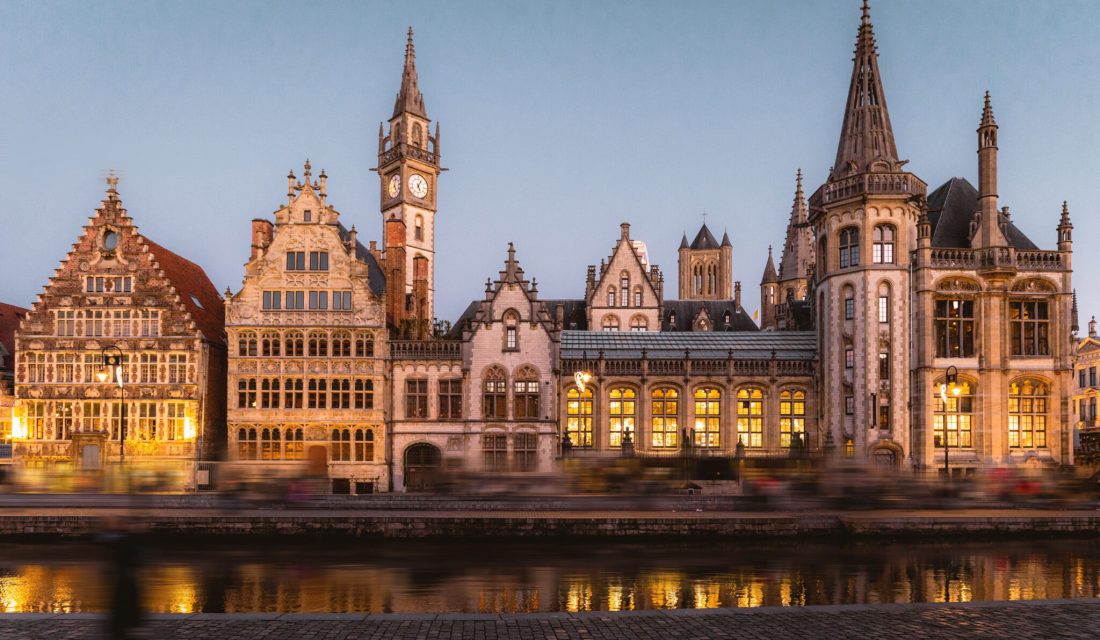
The prime residential market in Ghent will continue to be characterised by selectivity and a clear preference for quality in 2026. In the higher segment, location generally remains the most important factor, whilst finish, architecture and energy performance also play a significant role alongside factors such as floor area and price comparisons. For anyone wishing to buy, sell or position themselves in the top segment in Ghent, a detailed analysis of the market is more important than broad Belgian averages.
Ghent combines historical appeal, a strong knowledge- and service-based economy, and sustained demand for high-quality urban living. As a result, the city remains attractive to both Belgian buyers and international buyers seeking a high-quality home in East Flanders.
The market observations in this article are based on practical experience and available market signals. They are indicative in nature and reflect the situation as it stood at the time of publication. Market conditions can change rapidly.
What characterises the prime market in Ghent in 2026?
In Ghent, prime residential property is not just about high prices, but above all about houses and flats that excel in terms of location, appeal, privacy, quality of finish and long-term value retention. That is what distinguishes an expensive property from a genuine prime property.
Based on market signals and practical experience in Ghent, we anticipate that in 2026 there will be particular demand for:
- Characterful townhouses in prime city centres.
- High-quality, refurbished townhouses offering modern comforts.
- Spacious, premium flats and penthouses with terraces, plenty of light and views.
- Villas and residential properties in the upmarket suburbs around Ghent.
At the same time, the market has become more discerning. Buyers in this segment are less willing to compromise on energy performance certificates (EPCs), layout, outdoor space, parking convenience and the standard of finish. As a result, the gap is widening between properties that win buyers over straight away and those that, whilst offering potential, raise too many questions.
The key trends driving the market
1. Scarcity remains a key factor
Prime properties in Ghent remain relatively scarce, but supply in the higher end of the market can continue to evolve as new high-end listings come onto the market. For properties with an exceptional location, a strong architectural identity or a high-quality refurbishment, supply may remain limited in practice, whilst price levels in this segment are likely to remain fairly stable, according to market signals.
For sellers, this means that quality remains a powerful lever. For buyers, it means that truly distinctive opportunities often attract attention more quickly than general market sentiment would suggest. At the same time, market observations and published notarial statistics indicate that transaction volumes in the highest price segment for flats in Belgium are under some pressure, which further complicates the picture of selectivity in the prime segment.
2. Energy performance is becoming an increasingly important factor even in the luxury segment
By 2026, energy performance will have become significantly more important to many buyers in the higher-end market, although location generally remains the most important criterion. Even in the prime segment, buyers expect a property that combines aesthetics and comfort with a future-proof technical profile. This is particularly true of larger townhouses, mansions and older villas.
Properties with a high EPC rating, high-quality insulation, energy-efficient systems and well-planned renovations often retain a stronger market position. Properties with charm but in need of significant energy-efficiency improvements are more likely to prompt negotiations, even when the location is excellent.
It is important to note that a poor EPC rating does not merely have an impact on the market when a property is sold: an EPC rating of E or F triggers a statutory obligation to carry out renovation work upon sale for the buyer, who must carry out energy efficiency improvements within a specified timeframe in accordance with Flemish energy regulations. This factor is taken into account in the decision-making process and price negotiations, even in the luxury segment. The impact of interest rates in 2026 also plays a part in how buyers balance their budget and expectations.
3. Prime locations within Ghent continue to make the difference
Prime residential trends in Ghent in 2026 are strongly location-driven. Not every sought-after neighbourhood functions in the same way. In the higher-end segment, there is particular demand for areas that combine historical character, accessibility, quality of life and a strong residential profile.
Areas around the city centre, the most sought-after residential neighbourhoods and well-connected parts of Ghent with a high-quality streetscape remain attractive. The area around Gent-Sint-Pieters also remains appealing, particularly where accessibility and residential quality go hand in hand. Micro-location is crucial in this regard: views, tranquillity, street width, orientation and parking facilities have a direct impact on market interest.
4. Properties ready to move into perform better than those requiring work
In the high-end market, time is a key consideration. Many buyers are looking for a property that is architecturally sound and, at the same time, ready to move into straight away. This applies both to Belgian buyers looking to move up the property ladder and to international buyers who want a smooth purchase process.
Move-in-ready prime properties with a clear aesthetic, high-quality materials and a well-organised technical dossier generally sell more convincingly than properties where the potential has yet to be realised. The bar has been raised for renovation projects, as costs, timing and execution risks carry greater weight than they did a few years ago.
Which types of property are the most popular?
Demand in Ghent is not shifting en masse from one product type to another, but there is a clear preference for certain profiles within the higher-end segment.
| Property type | Why will it remain strong in 2026? |
|---|---|
| Mansion houses and period properties | Combine charm, an urban location and scarcity. |
| High-quality flats | Sought after by those downsizing, international buyers and those looking for comfort and convenience. |
| Penthouses | A rare property offering privacy, outdoor space and a distinctive character. |
| Villas on the outskirts of Ghent | Ideal for families looking to combine space, privacy and easy access. |
Premium flats and penthouses, in particular, remain attractive when they offer a cohesive whole: spacious living areas, plenty of light, a comfortable lift, high-quality outdoor space and sufficient privacy. In an urban setting such as Ghent, such properties are still in short supply.
Who buys prime property in Ghent?
The customer base in Ghent, in 2026, the market will be broad enough to ensure its resilience, yet selective enough to rigorously assess quality. In the higher end of the market, practical experience suggests that interest is coming primarily from:
- Belgian homebuyers looking to upgrade to a distinctive property within Ghent or from the surrounding area.
- Entrepreneurs and professionals who combine location, prestige and comfort.
- People downsizing from a larger house to a high-quality flat or penthouse.
- International buyers and expats who appreciate Ghent for its accessibility, cultural offerings and quality of life.
For international clients, local guidance remains important, particularly in a market where value depends heavily on micro-location, the urban context and the actual quality underlying a property’s presentation.
Pricing and negotiation in 2026
In the prime residential property market in Ghent, correct pricing remains essential. An exceptional property can attract a great deal of interest from the market, but even in the luxury segment, the market quickly corrects itself when the asking price, standard of finish and location are not fully in balance.
The strongest performance is generally seen in properties that are correctly positioned from the outset. Overly aggressive pricing tends to lead to longer selling times, more negotiation and weaker market dynamics. Correctly priced prime properties with a clear selling point regarding location, energy efficiency, architecture and presentation, on the other hand, retain their appeal.
For sellers, this is an important signal: the high-end market rewards exclusivity, but not a lack of commitment. For buyers, it means that competitively priced quality properties remain in short supply in Ghent. A well-founded valuation of luxury property is therefore crucial to maintaining market interest.
What does this mean for buyers and sellers?
For buyers
Anyone looking for a prime property in Ghent in 2026 would be well advised to adopt a selective approach. Not every property with a high asking price is automatically prime, and not every interesting opportunity remains on the market for long. The quality of the property’s documentation, its energy performance – including the statutory renovation requirement in the case of a poor EPC rating – its location and its future-proofing deserve particular attention.
For sellers
For owners of distinctive properties, Ghent remains a strong market, provided that the positioning and presentation are up to standard. In the luxury segment, prospective buyers expect a coherent narrative: an accurate valuation, high-quality visual presentation and an approach suited to a discreet and international clientele.
For properties in East and West Flanders, Christie’s International Real Estate Belgium offers support with the sale and marketing of exclusive residential property, with a regional presence in the Ghent market and access to an international network of prospective buyers.
A look ahead to the rest of 2026
The most likely scenario for the remainder of 2026 – based on current market signals – is not an abrupt reversal of the trend, but a further refinement of the market. High-quality properties in prime locations will continue to perform well, whilst average properties within a high price segment will be viewed more critically. Scarcity, energy efficiency and move-in readiness remain the three key drivers.
For anyone who actively follows the market in Ghent, the key point is clear: prime residential property remains attractive, but the distinction between truly exceptional properties and the broader high-end segment is becoming even more apparent. For further context, it is worth also looking at the broader trends in the luxury property market in Belgium in 2026.
Frequently asked questions
Which neighbourhoods in Ghent are most relevant for prime residential property?
That depends on the type of property and the desired lifestyle, but in the high-end market, factors such as residential quality, accessibility, architectural value, tranquillity and proximity to the city centre or major transport links are particularly important. In Ghent, the specific micro-location is often more decisive than the broader neighbourhood name.
Will energy-efficient homes remain important in the luxury segment too?
Yes. By 2026, buyers in the higher-end market will expect not only style and space, but also comfort, efficiency and future-proofing. At the same time, location generally remains the most important criterion. Furthermore, a poor EPC rating (E or F) triggers a statutory obligation for the buyer to carry out renovation work upon transfer of ownership, meaning that energy performance is not merely a market factor but also has a legal dimension.
Is Ghent of interest to international buyers in the high-end market?
Yes. Ghent appeals to international buyers thanks to its combination of historic charm, urban quality, accessibility and a relatively stable Belgian market environment. In particular, those looking for a high-quality home in Flanders regard Ghent as a credible prime location.
Which properties are in shortest supply in Ghent’s prime market?
In particular, exceptional townhouses, character properties ready to move into, spacious premium flats with terraces, and penthouses offering privacy and views remain in short supply. It is precisely this limited availability that underpins the segment’s appeal, whilst published market indicators and notarial statistics provide further insight into the broader Belgian picture.
'%3E%3Cg id='Group_551' data-name='Group 551' transform='translate(-74 -5252.672)'%3E%3Cg id='Group_542' data-name='Group 542' transform='translate(910 5353.672)' opacity='0.6'%3E%3Crect id='Rectangle_560' data-name='Rectangle 560' width='2.577' height='11.167' transform='translate(0 4.009)' fill='%23403f4b'/%3E%3Ccircle id='Ellipse_29' data-name='Ellipse 29' cx='1.5' cy='1.5' r='1.5' transform='translate(0.242)' fill='%23403f4b'/%3E%3Cpath id='Path_1184' data-name='Path 1184' d='M463.711,106.255c0-2.971-.643-5.255-4.119-5.255a3.612,3.612,0,0,0-3.25,1.782h-.048v-1.507H453v11.032h3.434v-5.457c0-1.439.273-2.833,2.06-2.833,1.76,0,1.786,1.646,1.786,2.925v5.365h3.432Z' transform='translate(-448.211 -96.989)' fill='%23403f4b'/%3E%3C/g%3E%3C/g%3E%3Cg id='Ellipse_33' data-name='Ellipse 33' transform='translate(820 85)' fill='none' stroke='%23e2e2e4' stroke-width='1'%3E%3Ccircle cx='24' cy='24' r='24' stroke='none'/%3E%3Ccircle cx='24' cy='24' r='23.5' fill='none'/%3E%3C/g%3E%3C/g%3E%3C/svg%3E)
'%3E%3Cg id='Group_552' data-name='Group 552' transform='translate(-53 -5253)'%3E%3Cg id='Group_545' data-name='Group 545' transform='translate(973 5355)' opacity='0.6'%3E%3Cg id='Group_544' data-name='Group 544'%3E%3Cpath id='Path_1186' data-name='Path 1186' d='M719.731,114h3.091v-7.5h2.385l.293-2.643h-2.679v-1.643c0-.584.243-.635.536-.635h2.1v-2.57L722.976,99a2.9,2.9,0,0,0-3.245,3.144v1.714H718V106.5h1.731Z' transform='translate(-718 -99)' fill='%23403f4b'/%3E%3C/g%3E%3C/g%3E%3C/g%3E%3Cg id='Ellipse_32' data-name='Ellipse 32' transform='translate(900 85)' fill='none' stroke='%23e2e2e4' stroke-width='1'%3E%3Ccircle cx='24' cy='24' r='24' stroke='none'/%3E%3Ccircle cx='24' cy='24' r='23.5' fill='none'/%3E%3C/g%3E%3C/g%3E%3C/svg%3E)
'%3E%3Cpath id='Subtraction_1' data-name='Subtraction 1' d='M10379.5,13h0c-.049,0-4.954-.046-6.458-.187-.072-.013-.158-.023-.258-.034a2.847,2.847,0,0,1-1.839-.754,3.952,3.952,0,0,1-.754-1.833A27,27,0,0,1,10370,7.2V5.8a26.984,26.984,0,0,1,.191-2.992,3.966,3.966,0,0,1,.754-1.835,2.667,2.667,0,0,1,1.785-.77h0l.114-.012c2.627-.184,6.606-.187,6.646-.187h.01c.039,0,4.019,0,6.647.187l.113.012h0a2.666,2.666,0,0,1,1.785.77,3.954,3.954,0,0,1,.754,1.835A27.618,27.618,0,0,1,10389,5.8V7.2a27.626,27.626,0,0,1-.189,2.994,3.949,3.949,0,0,1-.754,1.834,2.665,2.665,0,0,1-1.779.771l-.124.013C10383.518,12.991,10379.539,13,10379.5,13Zm-1.962-9.295,0,5.194,5.131-2.588Z' transform='translate(-9375.998 103)' fill='%23403f4b' stroke='rgba(0,0,0,0)' stroke-width='1' opacity='0.6'/%3E%3Cg id='Ellipse_31' data-name='Ellipse 31' transform='translate(980 85)' fill='none' stroke='%23e2e2e4' stroke-width='1'%3E%3Ccircle cx='24' cy='24' r='24' stroke='none'/%3E%3Ccircle cx='24' cy='24' r='23.5' fill='none'/%3E%3C/g%3E%3C/g%3E%3C/svg%3E)
'%3E%3Cg id='Ellipse_30' data-name='Ellipse 30' transform='translate(1062 5657)' fill='none' stroke='%23403f4b' stroke-width='1' opacity='0.15'%3E%3Ccircle cx='24' cy='24' r='24' stroke='none'/%3E%3Ccircle cx='24' cy='24' r='23.5' fill='none'/%3E%3C/g%3E%3Cpath id='Path_1264' data-name='Path 1264' d='M5.027-9.6a3.929,3.929,0,0,1,2.883-1.2,3.9,3.9,0,0,1,2.865,1.178A3.9,3.9,0,0,1,11.953-6.75a3.9,3.9,0,0,1-1.178,2.865A3.9,3.9,0,0,1,7.91-2.707,3.9,3.9,0,0,1,5.045-3.885,3.9,3.9,0,0,1,3.867-6.75,3.872,3.872,0,0,1,5.027-9.6Zm1.02,4.711a2.54,2.54,0,0,0,1.863.773,2.54,2.54,0,0,0,1.863-.773,2.54,2.54,0,0,0,.773-1.863,2.54,2.54,0,0,0-.773-1.863A2.54,2.54,0,0,0,7.91-9.387a2.54,2.54,0,0,0-1.863.773A2.54,2.54,0,0,0,5.273-6.75,2.54,2.54,0,0,0,6.047-4.887ZM12.762-11.6a.8.8,0,0,1,.281.633.943.943,0,0,1-.264.668.856.856,0,0,1-.65.281.913.913,0,0,1-.668-.281.913.913,0,0,1-.281-.668.856.856,0,0,1,.281-.65.943.943,0,0,1,.668-.264A.8.8,0,0,1,12.762-11.6ZM15.75-9.984q.035.949.035,3.234T15.75-3.516A4.848,4.848,0,0,1,14.467-.193a4.724,4.724,0,0,1-3.322,1.248q-.949.07-3.234.07t-3.234-.07a4.825,4.825,0,0,1-3.3-1.266A3.393,3.393,0,0,1,.633-1.2a4.974,4.974,0,0,1-.4-1.09,5.458,5.458,0,0,1-.123-1.23Q.035-4.465.035-6.75t.07-3.27a4.778,4.778,0,0,1,1.266-3.27,4.737,4.737,0,0,1,3.3-1.3q.949-.035,3.234-.035t3.234.035a4.848,4.848,0,0,1,3.322,1.283A4.848,4.848,0,0,1,15.75-9.984ZM14.063-2.109a3.813,3.813,0,0,0,.176-.721q.07-.439.105-1.055t.035-1V-8.613q0-.387-.035-1t-.105-1.055a3.813,3.813,0,0,0-.176-.721A2.537,2.537,0,0,0,12.551-12.9a3.813,3.813,0,0,0-.721-.176q-.439-.07-1.055-.105t-.984-.035H6.047q-.387,0-1,.035t-1.055.105a3.813,3.813,0,0,0-.721.176,2.537,2.537,0,0,0-1.512,1.512,3.813,3.813,0,0,0-.176.721q-.07.439-.105,1.055t-.035.984v3.375q0,.334.018.861t.053.9q.035.369.105.756t.141.633A2.665,2.665,0,0,0,3.27-.6a3.813,3.813,0,0,0,.721.176q.439.07,1.055.105t.984.035H9.773q.387,0,1-.035T11.83-.422A3.813,3.813,0,0,0,12.551-.6,2.665,2.665,0,0,0,14.063-2.109Z' transform='translate(1077.965 5687.625)' fill='%23403f4b' opacity='0.6'/%3E%3C/g%3E%3C/svg%3E)
' fill='%23403f4b'/%3E%3C/svg%3E)