
'%3E%3Cpath id='Path_1190' data-name='Path 1190' d='M0,0H33.5' transform='translate(1803.5 55.667)'/%3E%3Cpath id='Path_1190_-_Outline' data-name='Path 1190 - Outline' d='M33.5.5H0v-1H33.5Z' transform='translate(1803.5 55.667)'/%3E%3Cpath id='Line_11' data-name='Line 11' d='M33.5.5H0v-1H33.5Z' transform='translate(1803.5 68.667)'/%3E%3Cpath id='Line_7' data-name='Line 7' d='M33.5.5H0v-1H33.5Z' transform='translate(1803.5 42.667)'/%3E%3C/g%3E%3C/svg%3E%0A)
'%3E%3Cpath id='Line_69' data-name='Line 69' d='M31.646,32.354l-32-32L.354-.354l32,32Z' transform='translate(1878.5 10.5)'/%3E%3Cpath id='Line_70' data-name='Line 70' d='M.354,32.354l-.707-.707,32-32,.707.707Z' transform='translate(1878.5 10.5)'/%3E%3C/g%3E%3C/svg%3E)
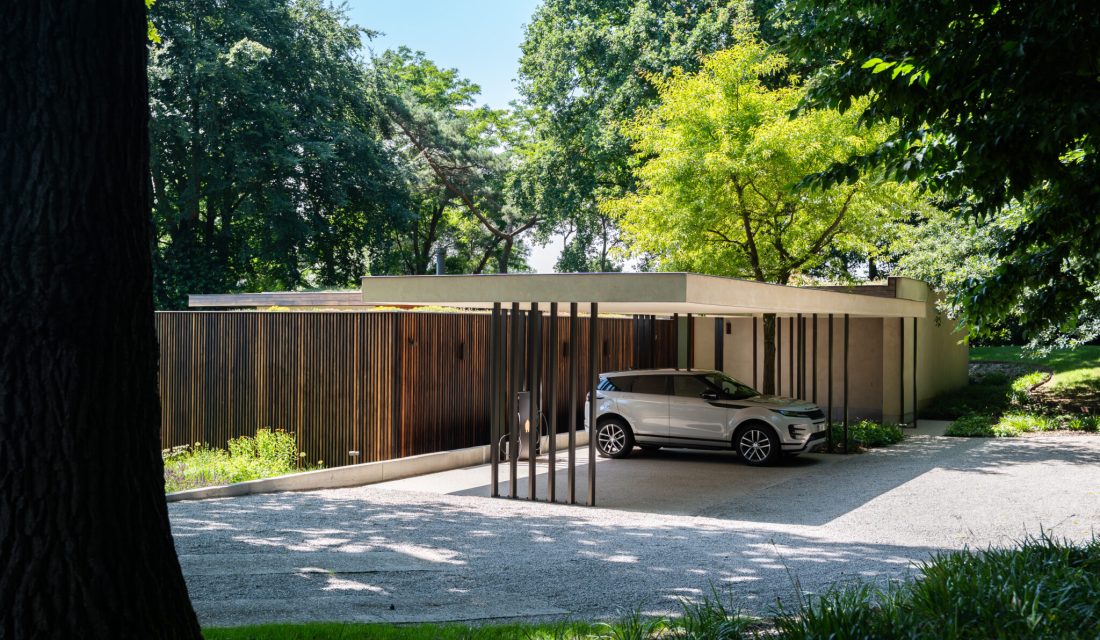
In the high-end residential sector, sustainability will become increasingly important in 2026. For buyers and sellers of luxury properties in Belgium, it is not just the architecture or location that matters, but also energy performance. Anyone wishing to assess the market accurately today must therefore look beyond aesthetics alone.
Sustainable homes often aim to meet higher standards of comfort and quality. In practice, this is reflected in homes where EPC information – which must be disclosed at the time of sale – explicitly includes A-ratings, solar panels or other energy-efficient features as part of the property’s marketing. The most relevant trends for 2026 therefore lie at the intersection of refined living, technical quality and long-term sustainable appeal.
What sustainability really means in a luxury home today
When it comes to luxury property, sustainability goes beyond simply lower energy consumption. It is about a home that retains its quality, remains a pleasant place to live in and better meets the expectations of a discerning buyer. In Belgium, this is becoming increasingly evident in the way high-end properties are assessed and presented.
A sustainable luxury home usually combines a number of features:
- High energy performance, as shown on the EPC or energy label.
- Lower operational costs thanks to efficient technologies and energy generation.
- A high standard of living thanks to a stable indoor climate and well-designed systems.
- Timeless quality that stands the test of time, both technically and aesthetically.
- Long-term market relevance in a sector where buyers are becoming increasingly selective.
It is precisely for this reason that sustainability is no longer a separate issue, but an integral part of how value is perceived. In the high-end market, it enhances a property’s appeal, particularly when its sustainable qualities can be clearly demonstrated.
Important for buyers: obligation to renovate if the EPC rating is poor
Anyone buying a property with EPC label E or F, is not only taking over a building with lower energy efficiency, but also a statutory renovation obligation. In accordance with Flemish energy regulations, the buyer must carry out renovation work within 6 years of the transfer to achieve at least an EPC rating of D. Following the renovation, a new EPC must be drawn up to demonstrate that the required energy efficiency rating has been achieved. This applies to purchases, gifts and other forms of transfer. It is crucial that buyers factor this obligation into their overall budget and purchase planning.
The key sustainability trends for luxury homes in Belgium in 2026
Energy performance is becoming more visible and more decisive
The most tangible trend is the growing focus on measurable energy performance. Whereas in the past, the first impression was dominated mainly by finish and size, today’s buyers also pay close attention to the EPC, energy label and energy consumption patterns. Particularly in Belgium, where energy performance also plays a key role in broader market communications and regulations, this criterion is becoming increasingly difficult to ignore.
When it comes to luxury homes, this does not mean that only new-build properties are relevant. Existing villas, townhouses and period properties are also being assessed more closely on their energy performance. A property with a favourable energy label or a convincing EPC score immediately conveys a forward-looking approach. This builds confidence, often lowers the barrier to decision-making and positions the property more strongly against less energy-efficient alternatives.
Renewable energy has evolved from being an added bonus to meeting expected quality standards
Solar panels and other forms of energy optimisation are increasingly regarded in the luxury segment as a natural part of a high-quality home. Not as a technical add-on, but as an element that is increasingly expected. This is reflected in property listings, which often include references to solar panels or favourable energy ratings.
For a buyer, this has a dual significance: the property feels contemporary whilst also conveying greater credibility in terms of sustainability. For a seller, it enhances the quality of the narrative surrounding the property, provided that the information is presented accurately, clearly and in a measurable way.
Comfort is increasingly seen as a measure of sustainability
By 2026, sustainability in high-end property will no longer be interpreted solely in technical terms. Comfort will also play a central role. A home that feels pleasant in every season and functions efficiently in everyday use often aligns in practice with what buyers expect from a high-quality, energy-efficient home.
This is important because luxury buyers are rarely looking for energy savings alone. Above all, they are seeking a high-quality living environment in which performance is discreetly integrated. When energy efficiency goes hand in hand with ease of use and a refined living experience, sustainability enhances luxury rather than being a separate technical issue.
Timeless quality trumps trend-driven choices
Another shift is the appreciation for homes that are sustainable in the broadest sense of the word: those that do not quickly go out of fashion, offer a high-quality feel in terms of materials, and prove their worth in the long term. This is particularly relevant in the luxury segment, as buyers here are less interested in fleeting trends and more focused on enduring quality.
This trend is reflected in a preference for homes in which architecture, finish and technical performance complement one another. It is not the most striking innovation that attracts the most attention, but rather the home that, taken as a whole, feels balanced, reliable and sustainable. This makes timelessness an essential part of sustainable luxury living.
Sustainable facilities are becoming an increasingly important part of property positioning
What is also striking, based on market signals for 2026, is that sustainability features are becoming a more prominent part of how exclusive properties are marketed. Not every property is marketed in the same way, but elements such as an A-label, a specific EPC rating, solar panels or other energy data are increasingly relevant in a property’s description.
For the market, this represents a clear shift: sustainability is no longer merely background information for the technical dossier, but also a factor in a property’s commercial appeal. Particularly for international or discerning buyers, clear energy information helps to set the right expectations more quickly.
Why these trends are particularly relevant in Belgium
The Belgian market has its own unique dynamics. On the one hand, there is a considerable supply of characterful and spacious homes that are aesthetically appealing, but do not always meet the same energy efficiency standards. On the other hand, demand is growing for properties that are ready for the future, without compromising on character or privacy. As a result, there is a growing appreciation in the luxury segment for homes that combine both qualities. Environmental factors also play a role here, such as soil certificates and flood risk reports at the time of sale.
Furthermore, Belgium is a market in which documentation and performance indicators play a tangible role in how a property is perceived. In this context, sustainability is increasingly becoming an objective selling point: objective because performance is visible.
What this means for buyers and sellers of luxury property
For buyers
Anyone looking for a luxury property in Belgium in 2026 would be well advised not to focus solely on location, architecture and the standard of finish. The property’s long-term sustainability also deserves to be a key factor in the assessment. Strong energy performance and clear technical information can make the difference between an attractive purchase and a property that loses its appeal more quickly.
Important point to note: if you buy a property with an EPC rating of E or F, you, as the buyer, are legally obliged to renovate the property within six years to achieve at least an EPC rating of D. Make sure to factor the cost of this renovation into your overall budget and always ask for the most recent EPC certificate and the accompanying recommendations when purchasing.
For sellers
For owners of exclusive properties, it is becoming increasingly important to clearly highlight their sustainable strengths. Not through exaggerated claims, but by presenting accurate and concrete information. In the luxury segment, nuance works better than hype: measurable performance and credible features underpin a sophisticated market positioning.
This is all the more true if your property already features elements that buyers will explicitly take into account in 2026, such as a favourable EPC rating or energy-saving features that contribute to a stronger sustainability profile. For those who also wish to take external market factors into account, the impact of interest rates in 2026 is a relevant consideration.
Frequently asked questions
Which sustainability features will stand out most in luxury homes in Belgium in 2026?
In particular, measurable energy performance, clear EPC information, favourable energy labels and visible energy solutions such as solar panels play an important role. In addition, the broader picture is also a key factor: comfort, future-proofing and timeless quality.
Are sustainability trends only relevant to new-build properties in the luxury segment?
No. Existing villas, townhouses and other exclusive properties are also increasingly being assessed on their sustainability credentials. Particularly in the case of properties with character, the combination of aesthetic appeal and improved energy performance can be a significant advantage. You should also bear in mind the renovation requirement for EPC ratings E or F: this also applies to the sale of existing properties.
Does a better EPC rating affect the appeal of a luxury property?
Yes. For many buyers, a strong EPC rating is an important indicator of quality and forward-thinking. In the luxury segment, it not only supports a rational assessment of a property, but also reinforces the overall impression of care, finish and reliability. Conversely, a poor rating (E or F) triggers a legal obligation for the buyer to carry out renovation work, which in turn affects the dynamics of the negotiations and the total cost of purchase.
Does aesthetics remain important when sustainability takes precedence?
Absolutely. In the high-end market, aesthetics and sustainability actually complement each other more than ever before. The most sought-after luxury homes combine architectural appeal with performance, comfort and compelling long-term value. Turnkey solutions for high-end homes can also be a good fit for those seeking forward-thinking living solutions.
'%3E%3Cg id='Group_551' data-name='Group 551' transform='translate(-74 -5252.672)'%3E%3Cg id='Group_542' data-name='Group 542' transform='translate(910 5353.672)' opacity='0.6'%3E%3Crect id='Rectangle_560' data-name='Rectangle 560' width='2.577' height='11.167' transform='translate(0 4.009)' fill='%23403f4b'/%3E%3Ccircle id='Ellipse_29' data-name='Ellipse 29' cx='1.5' cy='1.5' r='1.5' transform='translate(0.242)' fill='%23403f4b'/%3E%3Cpath id='Path_1184' data-name='Path 1184' d='M463.711,106.255c0-2.971-.643-5.255-4.119-5.255a3.612,3.612,0,0,0-3.25,1.782h-.048v-1.507H453v11.032h3.434v-5.457c0-1.439.273-2.833,2.06-2.833,1.76,0,1.786,1.646,1.786,2.925v5.365h3.432Z' transform='translate(-448.211 -96.989)' fill='%23403f4b'/%3E%3C/g%3E%3C/g%3E%3Cg id='Ellipse_33' data-name='Ellipse 33' transform='translate(820 85)' fill='none' stroke='%23e2e2e4' stroke-width='1'%3E%3Ccircle cx='24' cy='24' r='24' stroke='none'/%3E%3Ccircle cx='24' cy='24' r='23.5' fill='none'/%3E%3C/g%3E%3C/g%3E%3C/svg%3E)
'%3E%3Cg id='Group_552' data-name='Group 552' transform='translate(-53 -5253)'%3E%3Cg id='Group_545' data-name='Group 545' transform='translate(973 5355)' opacity='0.6'%3E%3Cg id='Group_544' data-name='Group 544'%3E%3Cpath id='Path_1186' data-name='Path 1186' d='M719.731,114h3.091v-7.5h2.385l.293-2.643h-2.679v-1.643c0-.584.243-.635.536-.635h2.1v-2.57L722.976,99a2.9,2.9,0,0,0-3.245,3.144v1.714H718V106.5h1.731Z' transform='translate(-718 -99)' fill='%23403f4b'/%3E%3C/g%3E%3C/g%3E%3C/g%3E%3Cg id='Ellipse_32' data-name='Ellipse 32' transform='translate(900 85)' fill='none' stroke='%23e2e2e4' stroke-width='1'%3E%3Ccircle cx='24' cy='24' r='24' stroke='none'/%3E%3Ccircle cx='24' cy='24' r='23.5' fill='none'/%3E%3C/g%3E%3C/g%3E%3C/svg%3E)
'%3E%3Cpath id='Subtraction_1' data-name='Subtraction 1' d='M10379.5,13h0c-.049,0-4.954-.046-6.458-.187-.072-.013-.158-.023-.258-.034a2.847,2.847,0,0,1-1.839-.754,3.952,3.952,0,0,1-.754-1.833A27,27,0,0,1,10370,7.2V5.8a26.984,26.984,0,0,1,.191-2.992,3.966,3.966,0,0,1,.754-1.835,2.667,2.667,0,0,1,1.785-.77h0l.114-.012c2.627-.184,6.606-.187,6.646-.187h.01c.039,0,4.019,0,6.647.187l.113.012h0a2.666,2.666,0,0,1,1.785.77,3.954,3.954,0,0,1,.754,1.835A27.618,27.618,0,0,1,10389,5.8V7.2a27.626,27.626,0,0,1-.189,2.994,3.949,3.949,0,0,1-.754,1.834,2.665,2.665,0,0,1-1.779.771l-.124.013C10383.518,12.991,10379.539,13,10379.5,13Zm-1.962-9.295,0,5.194,5.131-2.588Z' transform='translate(-9375.998 103)' fill='%23403f4b' stroke='rgba(0,0,0,0)' stroke-width='1' opacity='0.6'/%3E%3Cg id='Ellipse_31' data-name='Ellipse 31' transform='translate(980 85)' fill='none' stroke='%23e2e2e4' stroke-width='1'%3E%3Ccircle cx='24' cy='24' r='24' stroke='none'/%3E%3Ccircle cx='24' cy='24' r='23.5' fill='none'/%3E%3C/g%3E%3C/g%3E%3C/svg%3E)
'%3E%3Cg id='Ellipse_30' data-name='Ellipse 30' transform='translate(1062 5657)' fill='none' stroke='%23403f4b' stroke-width='1' opacity='0.15'%3E%3Ccircle cx='24' cy='24' r='24' stroke='none'/%3E%3Ccircle cx='24' cy='24' r='23.5' fill='none'/%3E%3C/g%3E%3Cpath id='Path_1264' data-name='Path 1264' d='M5.027-9.6a3.929,3.929,0,0,1,2.883-1.2,3.9,3.9,0,0,1,2.865,1.178A3.9,3.9,0,0,1,11.953-6.75a3.9,3.9,0,0,1-1.178,2.865A3.9,3.9,0,0,1,7.91-2.707,3.9,3.9,0,0,1,5.045-3.885,3.9,3.9,0,0,1,3.867-6.75,3.872,3.872,0,0,1,5.027-9.6Zm1.02,4.711a2.54,2.54,0,0,0,1.863.773,2.54,2.54,0,0,0,1.863-.773,2.54,2.54,0,0,0,.773-1.863,2.54,2.54,0,0,0-.773-1.863A2.54,2.54,0,0,0,7.91-9.387a2.54,2.54,0,0,0-1.863.773A2.54,2.54,0,0,0,5.273-6.75,2.54,2.54,0,0,0,6.047-4.887ZM12.762-11.6a.8.8,0,0,1,.281.633.943.943,0,0,1-.264.668.856.856,0,0,1-.65.281.913.913,0,0,1-.668-.281.913.913,0,0,1-.281-.668.856.856,0,0,1,.281-.65.943.943,0,0,1,.668-.264A.8.8,0,0,1,12.762-11.6ZM15.75-9.984q.035.949.035,3.234T15.75-3.516A4.848,4.848,0,0,1,14.467-.193a4.724,4.724,0,0,1-3.322,1.248q-.949.07-3.234.07t-3.234-.07a4.825,4.825,0,0,1-3.3-1.266A3.393,3.393,0,0,1,.633-1.2a4.974,4.974,0,0,1-.4-1.09,5.458,5.458,0,0,1-.123-1.23Q.035-4.465.035-6.75t.07-3.27a4.778,4.778,0,0,1,1.266-3.27,4.737,4.737,0,0,1,3.3-1.3q.949-.035,3.234-.035t3.234.035a4.848,4.848,0,0,1,3.322,1.283A4.848,4.848,0,0,1,15.75-9.984ZM14.063-2.109a3.813,3.813,0,0,0,.176-.721q.07-.439.105-1.055t.035-1V-8.613q0-.387-.035-1t-.105-1.055a3.813,3.813,0,0,0-.176-.721A2.537,2.537,0,0,0,12.551-12.9a3.813,3.813,0,0,0-.721-.176q-.439-.07-1.055-.105t-.984-.035H6.047q-.387,0-1,.035t-1.055.105a3.813,3.813,0,0,0-.721.176,2.537,2.537,0,0,0-1.512,1.512,3.813,3.813,0,0,0-.176.721q-.07.439-.105,1.055t-.035.984v3.375q0,.334.018.861t.053.9q.035.369.105.756t.141.633A2.665,2.665,0,0,0,3.27-.6a3.813,3.813,0,0,0,.721.176q.439.07,1.055.105t.984.035H9.773q.387,0,1-.035T11.83-.422A3.813,3.813,0,0,0,12.551-.6,2.665,2.665,0,0,0,14.063-2.109Z' transform='translate(1077.965 5687.625)' fill='%23403f4b' opacity='0.6'/%3E%3C/g%3E%3C/svg%3E)
' fill='%23403f4b'/%3E%3C/svg%3E)