
'%3E%3Cpath id='Path_1190' data-name='Path 1190' d='M0,0H33.5' transform='translate(1803.5 55.667)'/%3E%3Cpath id='Path_1190_-_Outline' data-name='Path 1190 - Outline' d='M33.5.5H0v-1H33.5Z' transform='translate(1803.5 55.667)'/%3E%3Cpath id='Line_11' data-name='Line 11' d='M33.5.5H0v-1H33.5Z' transform='translate(1803.5 68.667)'/%3E%3Cpath id='Line_7' data-name='Line 7' d='M33.5.5H0v-1H33.5Z' transform='translate(1803.5 42.667)'/%3E%3C/g%3E%3C/svg%3E%0A)
'%3E%3Cpath id='Line_69' data-name='Line 69' d='M31.646,32.354l-32-32L.354-.354l32,32Z' transform='translate(1878.5 10.5)'/%3E%3Cpath id='Line_70' data-name='Line 70' d='M.354,32.354l-.707-.707,32-32,.707.707Z' transform='translate(1878.5 10.5)'/%3E%3C/g%3E%3C/svg%3E)
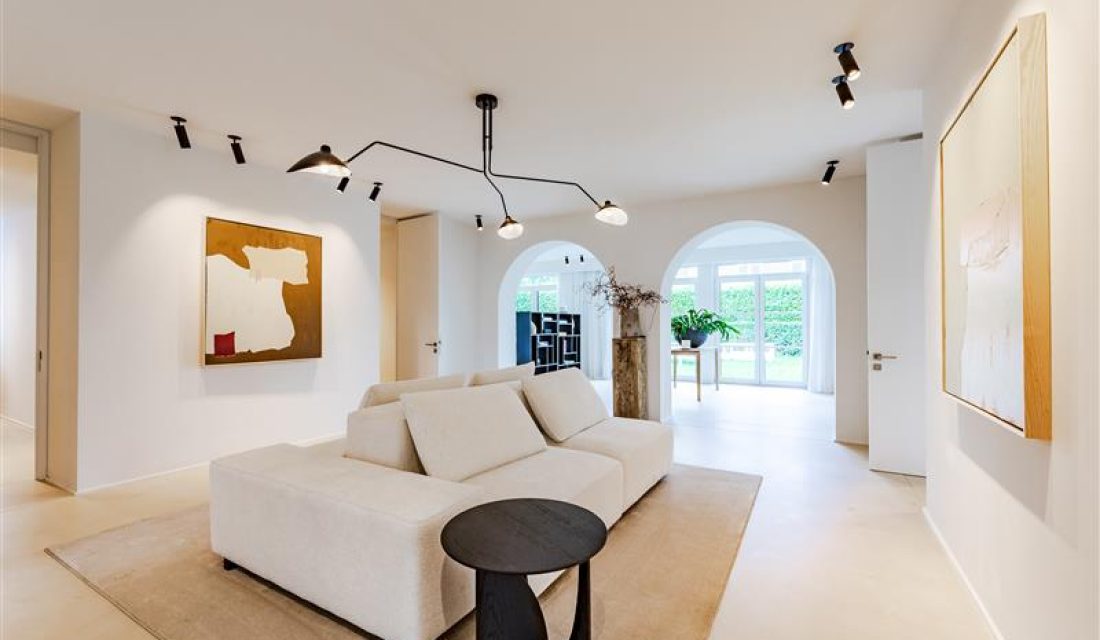
Architectural lighting in luxury homes
In a luxury home, light shapes far more than just what you see. It sets the mood, emphasizes architectural lines, and makes materials, art and sight lines perceptible. Anyone assessing exclusive real estate therefore looks not only at floor area and finish, but also at how lighting lifts the living experience to a higher level.
Why architectural lighting is so decisive in the high-end segment
In exclusive real estate, every element must contribute to the home’s overall experience. Lighting plays a key role because it works both functionally and emotionally. By day it supports the relationship with daylight, views and a sense of space. Once it’s dark, artificial light takes over and determines how a home feels.
In luxury homes, architectural lighting is rarely accidental. It supports, among other things:
- Architecture – by making volumes, ceiling heights, niches, staircases and sight lines legible
- Materials – by allowing stone, wood, metal, texture and bespoke finishes to come into their own
- Ambience – from intimate and warm to bright and representative
- Use – so that living, entertaining, relaxing and working each get an appropriate light level
- Exclusivity – because refined lighting makes the home feel more coherent, richer and more carefully designed
This is precisely why lighting in high-end homes is best not seen as a finishing touch, but as an integral part of the design and the living experience. Especially in new construction it is valuable to integrate the lighting plan early in the design phase.
How good lighting strengthens a home’s architecture
A strong lighting concept doesn’t make architecture louder, but clearer. It guides the eye, places accents where needed and leaves calm where that works better. In luxury real estate this is essential, because value often lies in proportion, material choices and detailing.
For example, indirect light can make a ceiling feel higher, while focused accents create depth and focus. Vertical illumination on walls generally gives a space more grandeur than light solely from above. Subtle integration in niches, staircases or bespoke joinery ensures the technology remains subordinate to the design.
Outdoors this matters as well. A refined facade, a driveway, a garden structure or a terrace gains expression when light not only illuminates but composes. In practice it often comes down to balance and layering, so the evening experience gains depth and atmosphere without becoming too harsh or intrusive.
The key characteristics of architectural lighting in luxury homes
Although every home is unique, a few principles recur frequently in the high-end segment. They help you read a property’s quality more clearly.
Layered light instead of a single uniform solution
A luxury home rarely relies on just one type of lighting per room. Quality usually emerges from an interplay of ambient light, accent lighting and mood lighting. This allows the same space to adapt to different times of day and different ways of living.
Attention to sight lines and experience
In high-end architecture, what you see from an entrance, living area or hallway is often deliberately composed. Lighting supports that composition by drawing attention to art, bespoke elements, vistas or characterful materials.
Discreet integration
In a refined interior, lighting ideally stands out by its effect, not by visual noise. Recessed lines, concealed light sources and carefully chosen fixtures bring calm and elegance.
Tuned to day and night
By day, artificial light should not disrupt the natural rhythm. In the evening it should bring warmth, comfort and depth. Good architectural lighting considers both situations.
Technology that supports comfort
In some luxury homes, an advanced home automation system increases ease of use, for example by centralising control or activating scenes. When done well, technology enhances the quality of living without disturbing the interior’s serenity. Combine this with energy-efficient luminaires and high-quality LEDs, in line with the EPC and energy requirements 2026, and you pair comfort with lower consumption profiles.
What to look for when evaluating a luxury home
For buyers and sellers in the high-end segment, lighting is not just an aesthetic detail. It also influences how convincing a home feels during a visit, presentation or viewing.
- Does the home feel equally strong in the evening? Some properties impress in daylight but lose character as soon as artificial light takes over.
- Are the architectural assets truly supported? Think of a double-height space, staircase, bespoke joinery, fireplace feature, facade elements or long sight lines.
- Is there a balance between ambience and functionality? Exclusive living calls for comfort, but also usability in the kitchen, bathroom, dressing, study or circulation areas.
- Does the lighting match the level of the home? High-end finishes call for the same refinement in lighting experience and control.
- Is there cohesion between indoors and outdoors? In premium real estate, outdoor lighting also contributes to appearance, safety and the evening experience.
This is relevant for owners because lighting strongly influences the presentation of a home. For prospective buyers it helps distinguish why one property convinces immediately and another resonates less, especially within a turnkey concept for high-end homes where design and execution are closely aligned.
Lighting, home automation and modern luxury
In contemporary luxury homes, comfort and discretion often go hand in hand. Lighting increasingly forms part of a broader whole in which control is intuitive and the home adapts to the moment. Think of indirect lighting, mood scenes or lighting controlled via a central system. Evolutions such as smart lighting and circadian lighting are gaining importance; see also the Luxury real estate trends 2026.
Why this also matters for property value and presentation
In the luxury segment, a home is not chosen purely rationally. Emotion, atmosphere and refinement play a major role in the perception of value. Architectural lighting influences precisely those factors and contributes to value creation through experience.
A home with a strong lighting experience usually appears more considered, more inviting and architecturally stronger. That makes it not only more pleasant to live in, but also more compelling to present to a discreet and demanding audience. Especially in a market where international buyers often judge quality, finish and overall impression quickly, lighting can make the difference between mere interest and true appeal. Inspiration from case studies on prestigious residences in Brussels shows how architecture, appearance and the living experience reinforce one another.
FAQ
How much does a lighting plan for a house cost?
That depends heavily on the size of the home, the complexity of the design and the desired integration. In luxury homes, lighting is often considered part of the overall living quality, so custom work and coordination play a larger role than in standard projects.
How can I simulate daylight in my home?
Artificial light can be tuned to partially approximate daylight patterns, for example by varying intensity and colour temperature throughout the day (cooler and brighter during the day, warmer in the evening). Important factors include distribution, direction, intensity and the relationship with materials and sight lines in the home.
What makes a home luxury?
Luxury rarely lies in a single element. It is usually a combination of location, architecture, spatial experience, level of finish, privacy, comfort and coherence in the design. Architectural lighting reinforces that overall impression and makes quality visible at the right moments, as shown by examples of architectural perfection and inspiring living stories.
'%3E%3Cg id='Group_551' data-name='Group 551' transform='translate(-74 -5252.672)'%3E%3Cg id='Group_542' data-name='Group 542' transform='translate(910 5353.672)' opacity='0.6'%3E%3Crect id='Rectangle_560' data-name='Rectangle 560' width='2.577' height='11.167' transform='translate(0 4.009)' fill='%23403f4b'/%3E%3Ccircle id='Ellipse_29' data-name='Ellipse 29' cx='1.5' cy='1.5' r='1.5' transform='translate(0.242)' fill='%23403f4b'/%3E%3Cpath id='Path_1184' data-name='Path 1184' d='M463.711,106.255c0-2.971-.643-5.255-4.119-5.255a3.612,3.612,0,0,0-3.25,1.782h-.048v-1.507H453v11.032h3.434v-5.457c0-1.439.273-2.833,2.06-2.833,1.76,0,1.786,1.646,1.786,2.925v5.365h3.432Z' transform='translate(-448.211 -96.989)' fill='%23403f4b'/%3E%3C/g%3E%3C/g%3E%3Cg id='Ellipse_33' data-name='Ellipse 33' transform='translate(820 85)' fill='none' stroke='%23e2e2e4' stroke-width='1'%3E%3Ccircle cx='24' cy='24' r='24' stroke='none'/%3E%3Ccircle cx='24' cy='24' r='23.5' fill='none'/%3E%3C/g%3E%3C/g%3E%3C/svg%3E)
'%3E%3Cg id='Group_552' data-name='Group 552' transform='translate(-53 -5253)'%3E%3Cg id='Group_545' data-name='Group 545' transform='translate(973 5355)' opacity='0.6'%3E%3Cg id='Group_544' data-name='Group 544'%3E%3Cpath id='Path_1186' data-name='Path 1186' d='M719.731,114h3.091v-7.5h2.385l.293-2.643h-2.679v-1.643c0-.584.243-.635.536-.635h2.1v-2.57L722.976,99a2.9,2.9,0,0,0-3.245,3.144v1.714H718V106.5h1.731Z' transform='translate(-718 -99)' fill='%23403f4b'/%3E%3C/g%3E%3C/g%3E%3C/g%3E%3Cg id='Ellipse_32' data-name='Ellipse 32' transform='translate(900 85)' fill='none' stroke='%23e2e2e4' stroke-width='1'%3E%3Ccircle cx='24' cy='24' r='24' stroke='none'/%3E%3Ccircle cx='24' cy='24' r='23.5' fill='none'/%3E%3C/g%3E%3C/g%3E%3C/svg%3E)
'%3E%3Cpath id='Subtraction_1' data-name='Subtraction 1' d='M10379.5,13h0c-.049,0-4.954-.046-6.458-.187-.072-.013-.158-.023-.258-.034a2.847,2.847,0,0,1-1.839-.754,3.952,3.952,0,0,1-.754-1.833A27,27,0,0,1,10370,7.2V5.8a26.984,26.984,0,0,1,.191-2.992,3.966,3.966,0,0,1,.754-1.835,2.667,2.667,0,0,1,1.785-.77h0l.114-.012c2.627-.184,6.606-.187,6.646-.187h.01c.039,0,4.019,0,6.647.187l.113.012h0a2.666,2.666,0,0,1,1.785.77,3.954,3.954,0,0,1,.754,1.835A27.618,27.618,0,0,1,10389,5.8V7.2a27.626,27.626,0,0,1-.189,2.994,3.949,3.949,0,0,1-.754,1.834,2.665,2.665,0,0,1-1.779.771l-.124.013C10383.518,12.991,10379.539,13,10379.5,13Zm-1.962-9.295,0,5.194,5.131-2.588Z' transform='translate(-9375.998 103)' fill='%23403f4b' stroke='rgba(0,0,0,0)' stroke-width='1' opacity='0.6'/%3E%3Cg id='Ellipse_31' data-name='Ellipse 31' transform='translate(980 85)' fill='none' stroke='%23e2e2e4' stroke-width='1'%3E%3Ccircle cx='24' cy='24' r='24' stroke='none'/%3E%3Ccircle cx='24' cy='24' r='23.5' fill='none'/%3E%3C/g%3E%3C/g%3E%3C/svg%3E)
'%3E%3Cg id='Ellipse_30' data-name='Ellipse 30' transform='translate(1062 5657)' fill='none' stroke='%23403f4b' stroke-width='1' opacity='0.15'%3E%3Ccircle cx='24' cy='24' r='24' stroke='none'/%3E%3Ccircle cx='24' cy='24' r='23.5' fill='none'/%3E%3C/g%3E%3Cpath id='Path_1264' data-name='Path 1264' d='M5.027-9.6a3.929,3.929,0,0,1,2.883-1.2,3.9,3.9,0,0,1,2.865,1.178A3.9,3.9,0,0,1,11.953-6.75a3.9,3.9,0,0,1-1.178,2.865A3.9,3.9,0,0,1,7.91-2.707,3.9,3.9,0,0,1,5.045-3.885,3.9,3.9,0,0,1,3.867-6.75,3.872,3.872,0,0,1,5.027-9.6Zm1.02,4.711a2.54,2.54,0,0,0,1.863.773,2.54,2.54,0,0,0,1.863-.773,2.54,2.54,0,0,0,.773-1.863,2.54,2.54,0,0,0-.773-1.863A2.54,2.54,0,0,0,7.91-9.387a2.54,2.54,0,0,0-1.863.773A2.54,2.54,0,0,0,5.273-6.75,2.54,2.54,0,0,0,6.047-4.887ZM12.762-11.6a.8.8,0,0,1,.281.633.943.943,0,0,1-.264.668.856.856,0,0,1-.65.281.913.913,0,0,1-.668-.281.913.913,0,0,1-.281-.668.856.856,0,0,1,.281-.65.943.943,0,0,1,.668-.264A.8.8,0,0,1,12.762-11.6ZM15.75-9.984q.035.949.035,3.234T15.75-3.516A4.848,4.848,0,0,1,14.467-.193a4.724,4.724,0,0,1-3.322,1.248q-.949.07-3.234.07t-3.234-.07a4.825,4.825,0,0,1-3.3-1.266A3.393,3.393,0,0,1,.633-1.2a4.974,4.974,0,0,1-.4-1.09,5.458,5.458,0,0,1-.123-1.23Q.035-4.465.035-6.75t.07-3.27a4.778,4.778,0,0,1,1.266-3.27,4.737,4.737,0,0,1,3.3-1.3q.949-.035,3.234-.035t3.234.035a4.848,4.848,0,0,1,3.322,1.283A4.848,4.848,0,0,1,15.75-9.984ZM14.063-2.109a3.813,3.813,0,0,0,.176-.721q.07-.439.105-1.055t.035-1V-8.613q0-.387-.035-1t-.105-1.055a3.813,3.813,0,0,0-.176-.721A2.537,2.537,0,0,0,12.551-12.9a3.813,3.813,0,0,0-.721-.176q-.439-.07-1.055-.105t-.984-.035H6.047q-.387,0-1,.035t-1.055.105a3.813,3.813,0,0,0-.721.176,2.537,2.537,0,0,0-1.512,1.512,3.813,3.813,0,0,0-.176.721q-.07.439-.105,1.055t-.035.984v3.375q0,.334.018.861t.053.9q.035.369.105.756t.141.633A2.665,2.665,0,0,0,3.27-.6a3.813,3.813,0,0,0,.721.176q.439.07,1.055.105t.984.035H9.773q.387,0,1-.035T11.83-.422A3.813,3.813,0,0,0,12.551-.6,2.665,2.665,0,0,0,14.063-2.109Z' transform='translate(1077.965 5687.625)' fill='%23403f4b' opacity='0.6'/%3E%3C/g%3E%3C/svg%3E)
' fill='%23403f4b'/%3E%3C/svg%3E)